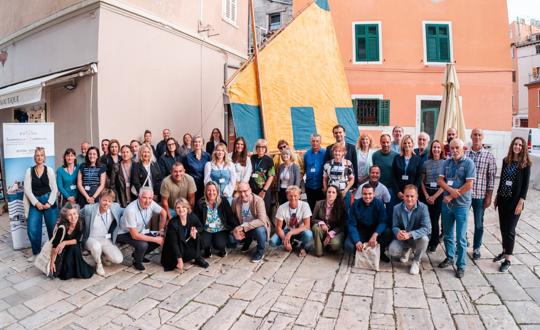
Maritime heritage lives when it is talked about, when knowledge and skills are passed on, and when the experiences of different communities connect and transform into new ideas. That exact thought served as the guiding line for the three-day conference held from October 2 to 4, 2026, in Rovinj-Rovigno, which brought together numerous members of the academic community, museum professionals, representatives of institutions and associations, as well as holders of traditional knowledge and skills related to the sea, fishing, and shipbuilding.
This was the third edition of the Conference on the Preservation and Interpretation of the Maritime Heritage of Croatia, which—following Rijeka and Betina—was held in Rovinj-Rovigno. It was organized by the Institution and Association "Kuća o batani – Casa della batana" Rovinj-Rovigno, the Maritime and History Museum of the Croatian Littoral Rijeka, the Croatian Maritime Museum Split, the Museum of Betina Wooden Shipbuilding, and the Coordination of Associations for the Preservation and Revitalization of Maritime, Fishing, and Shipbuilding Heritage of Kvarner and Istria.
This year's edition took place in a particularly significant year for the host, as Rovinj's Ekomuzej-Ecomuseo "Batana" marks ten years since its inscription on the UNESCO Register of Good Safeguarding Practices for Intangible Cultural Heritage. The international dimension of the event was highlighted by a round table organized in cooperation with the UNESCO Regional Centre in Sofia, opening up a space to exchange experiences and perspectives from South-Eastern European countries.
Furthermore, the rich program of the conference bore witness to the diversity of topics and approaches. Across five thematic sessions, more than 30 presenters spoke about the work of interpretation centers, maritime heritage museum collections, local events, and projects aimed at preserving traditional skills in Umag-Umago, Tar-Vabriga – Torre-Abrega, Vrsar-Orsera, Rovinj-Rovigno, Pula-Pola, Rijeka, Bakarac, Zadar, Split, and on the islands of Krk, Cres, and Vis.
From Traditional Skills to Digital Documentation…
The focus was on contemporary methods for the digital documentation of traditional wooden boats and archaeological ships. Discussions also covered the sustainability of interpretation centers, the revitalization of traditional vessels, the possibilities of establishing an Adriatic maritime heritage network, and how experiences gained through various projects and initiatives can grow into long-term cooperation.
An important part of the program was dedicated to youth through educational scale models, creative workshops, school programs, and other ways of engaging younger generations in preserving traditional knowledge and skills.
The special value of the conference lay precisely in the diversity of the presented experiences. Participants demonstrated that preserving maritime heritage involves not only protecting traditional vessels and artifacts, but also safeguarding knowledge and skills, involving the local community, engaging younger generations, developing innovative interpretive content, using modern technologies, and creating new pathways to make heritage more visible and accessible to a broader audience.
Additionally, updates were presented regarding the initiative launched during the previous edition of the conference—specifically, the Betina Declaration, through which participants supported the idea of launching a vocational high school track for "Wooden Boatbuilder." It was confirmed that a vocational curriculum has since been drafted and submitted to the Ministry of Science and Education, where it is currently awaiting response and the necessary approvals.
New Ideas for Stronger Connections and Heritage Practice Development
Regarding the new initiatives generated by the conference in Rovinj-Rovigno, two key ideas stood out, aimed at fostering stronger connections among stakeholders and improving the institutional framework for maritime heritage preservation and interpretation.
The first concerns establishing a network of institutions and associations working in maritime heritage to enable continuous collaboration and strengthen connections among members.
The second addresses the institutionalization of new forms of heritage practice—namely, the legal status of interpretation centers, museums, and eco-museums, along with appropriate terminology. It was therefore proposed to conduct research and/or hold an expert meeting whose conclusions would be presented to all relevant stakeholders and the Ministry of Culture and Media, advocating for a revision of existing regulations and a clearer definition of status and terminology.
In addition to the professional program, participants had the opportunity to experience Rovinj's living maritime heritage firsthand through demonstration rowing and sailing in *batana* boats, a traditional skills workshop, and a guided tour of the Rovinj archipelago.
The overall impression of the successful conference was summarized by Nives Giuricin, Director of the Institution-Istituzione "Kuća o batani – Casa della batana": "Over these days, our town truly lived its maritime heritage through knowledge, discussions, encounters, and the experiences of the people who protect it and pass it on. In the company of colleagues from Dalmatia, Kvarner, Istria, and Zagreb, as well as UNESCO and AMMM, we celebrated the 10th anniversary of Ekomuzej-Ecomuseo 'Batana' being inscribed on the UNESCO Register of Good Safeguarding Practices in the best possible way. After the official part of the conference, emotion remained—smiles, hugs, new friendships, gratitude, and a feeling that together we achieved something truly valuable. And perhaps that emotion is the best proof that we are on the right track. Heritage is not just what we preserve; heritage is what we live, feel, and pass on to others. Thanks to everyone who was part of our story, we are already looking ahead to Orebić, which will host the fourth conference in 2027 on the preservation and interpretation of our country's truly rich maritime heritage."